

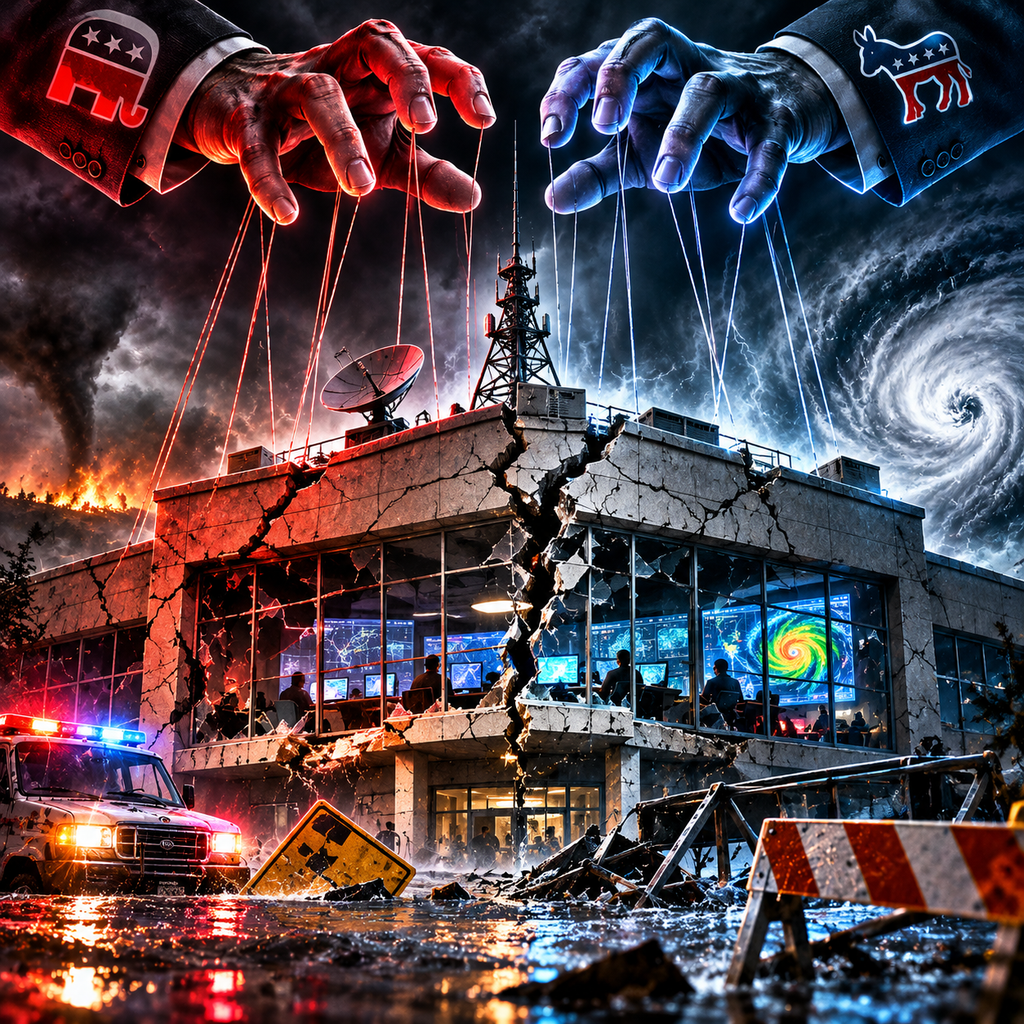
The Collapse Risk Created by Politicizing Emergency Management and Emergency Operations
Emergency Management, Emergency Response, Law Enforcement, and the Military exist to serve the public without political alignment or ideological preference. Among these, Emergency Management occupies a uniquely critical role: it is the coordinating function upon which all others depend. When Emergency Management loses impartiality, the entire system is placed at risk of collapse.
As a retired Emergency Manager, I state this without hesitation: the rhetoric and conduct observed in Minnesota over the past 24 hours are deeply alarming — not merely controversial, but operationally dangerous.
Following the fatal shooting of an armed attacker during a CBP operation in Minneapolis, senior state officials delivered press briefings that went well beyond factual updates or public reassurance. The Governor publicly condemned federal law enforcement actions, declared exclusive state authority over the investigation, announced evidentiary collection aimed at prosecuting federal officers, questioned the legitimacy of federal law enforcement as “law enforcement,” and encouraged the public to document and photograph ICE and CBP agents.
This alone represents a serious breakdown in intergovernmental discipline. However, what is more troubling — far more troubling — is the role played by Emergency Management leadership.
Emergency Management is not an advocacy function. It is not a messaging platform. It is not a political shield. It is a neutral coordination and credibility function, designed to unify effort, reduce friction, and preserve public trust during crisis. FEMA doctrine, NIMS, and ICS principles all emphasize impartiality, unity of command, and credibility precisely because these systems fail catastrophically when perceived as partisan.1
When an Emergency Management Director publicly compares domestic law enforcement operations to foreign conflict zones, the damage is immediate and severe. Such language signals to the public that lawful responders are an occupying force rather than a coordinating authority.
That perception directly undermines responder safety, fuels escalation, and fractures trust across every discipline involved.
This is not a policy disagreement — it is a violation of Emergency Management’s most basic professional obligation: to remain neutral so others can operate safely.
Emergency Managers are entrusted with credibility capital that does not belong to them personally, but is loaned to them by the public for the duration of crisis. It belongs to the system. Spending that credibility on political framing is not leadership; it is institutional malpractice.
Equally concerning is the manner in which public communications were handled.
Press briefings following emergency incidents under active response or stabilization should be conducted in accordance with Incident Command System (ICS) principles. That means:
Operational control over the press briefing belongs to a trained Public Information Officer (PIO) fluent and operating within the incident command structure
Verified, operationally cleared information released in coordination with command staff
Subject-matter details provided by appropriate operational leaders, as needed
This structure exists for a reason: to prevent speculation, politicization, and contradictory messaging during dynamic and potentially violent situations.2
The role of elected officials during active emergency operations press briefings is narrow and well understood. It is to:
Express support for the responding agencies
Reassure the public that resources are being applied
Reinforce unity of effort
It is not the place for ideological statements, accusations, narrative framing, or partisan commentary. When politicians use emergency press conferences as political platforms, they actively undermine the very response they are claiming to support, and erode the trust in future emergency operations and press briefings nationwide.
The contrast between briefings in this incident is instructive. CBP leadership confined remarks to verified facts, operational context, and limited responses to questions. No rhetoric. No speculation. No political framing. That is what apolitical professionalism looks like under pressure.
By comparison, state-level briefings introduced accusatory language, rejected federal accounts outright, and encouraged civilian involvement in documenting federal officers — actions that materially increase risk to responders and the public alike.
History demonstrates where this leads. During the 1992 Rodney King riots, firefighters were forced to suspend responses in multiple areas because they were being shot at while attempting lifesaving operations.3 Emergency response did not fail because responders lacked courage — it failed because legitimacy, coordination, and control had eroded.
The Constitution anticipates these breakdowns. The Insurrection Act exists to address precisely these circumstances, where state and local authorities are unable or unwilling to restore order and protect constitutional rights.4 Supporting its invocation is not extreme; it is an acknowledgment that disorder itself is incompatible with liberty. I do not want to see the Act invoked, but I don’t want to see Minneapolis burn again like it did in 2020.5 An unlawful assembly was called hours ago. Instead of using available state and local resources to disperse the assembly they declared unlawful, they now call it peaceful and condone the continued violation of law and order.
Compounding these concerns are reports that federal officers requesting assistance through 911 have experienced delayed or absent responses. If accurate, this represents a fundamental breakdown in mutual aid obligations. Emergency response cannot function if assistance is contingent on political alignment.
Emergency Management must remain boringly, stubbornly apolitical — especially when tensions are highest. Once that neutrality is lost, every responder becomes a symbol, every action becomes suspect, and every institution becomes a potential adversary.
This is not sustainable. And it is not acceptable.
Leadership in crisis demands restraint, discipline, and fidelity to doctrine. Facts must precede narratives. Coordination must override ideology. Emergency Management must remain neutral — or the system fails where it can least afford to.
With a severe snow and ice storm bearing down on more than 200 million people across 35 states, 18 of which along with Washington, D.C. have declared states of emergency, and at least nine of which have activated their National Guards, I think it’s safe to say that this is exactly when the Emergency Management system can least afford to fail.
- FEMA, Guiding Principles of Emergency Management; National Incident Management System (NIMS) ↩︎
- FEMA, Incident Command System (ICS) – Public Information Officer (PIO) Role ↩︎
- U.S. DOJ, Report of the Independent Commission on the Los Angeles Police Department (1992) ↩︎
- 10 U.S.C. §§ 251–255 (Insurrection Act) ↩︎
- U.S. Attorney’s Office, District of Minnesota, St. Paul Man Sentenced To Prison, $12 Million In Restitution For
Minneapolis Police Third Precinct Arson, Press Release, May 2021 ↩︎